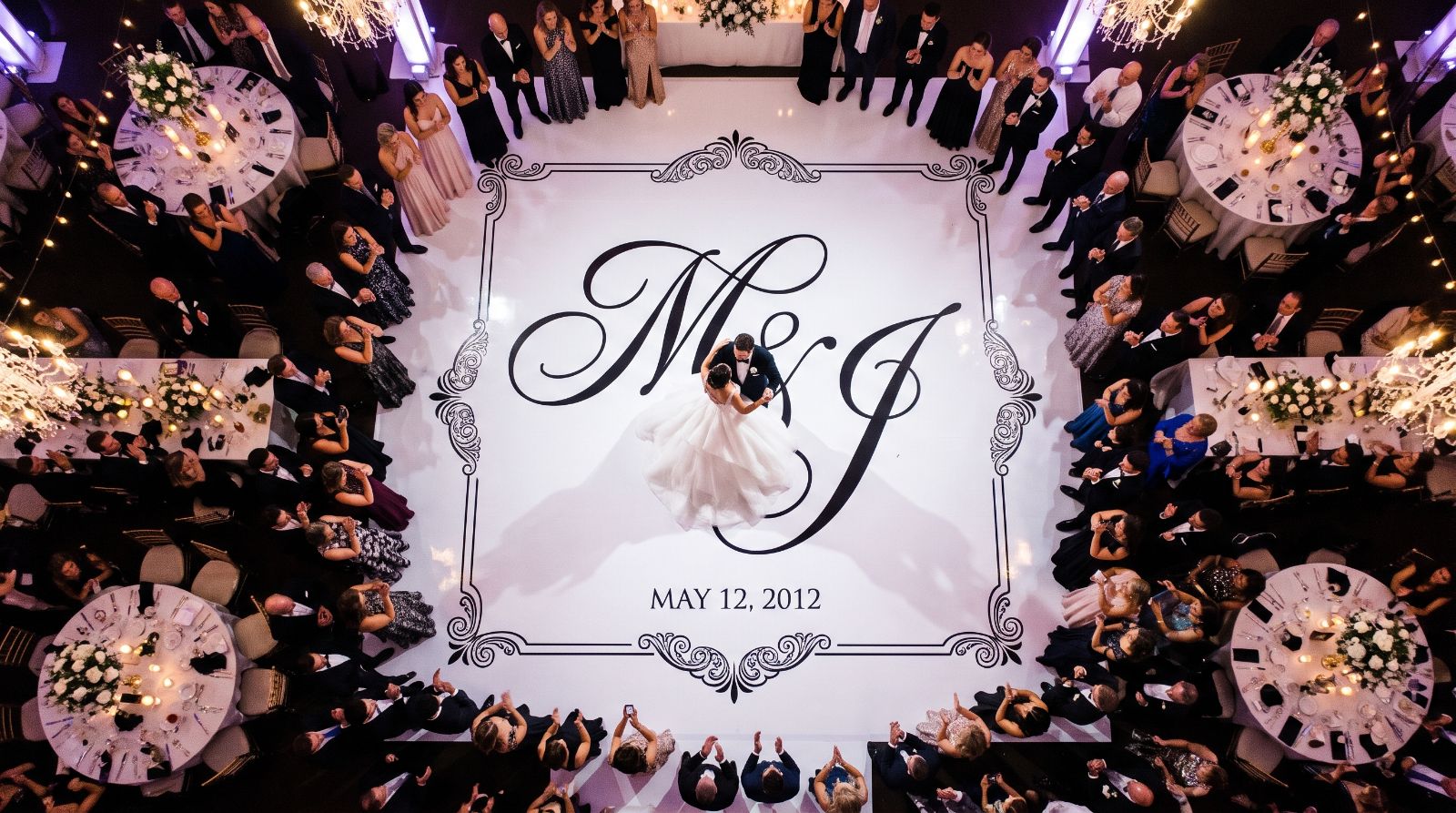
Plan on roughly 4.5 square feet for each person dancing, and expect about 40 to 50 percent of wedding guests to be on the floor at the busiest moment. For 100 guests, that works out to about 180 to 225 sq ft, or a floor around 14 x 14 ft to 15 x 15 ft. Below is a guest-count table, how portable floor panels affect the final size, and exactly how to measure for a wrap.
The rule of thumb, and the math
Event planners and rental companies typically size dance floors at about 4 to 5 square feet per dancer, with 4.5 sq ft the most common working number. That’s enough room to move without bumping elbows, but tight enough that the floor feels full.
The second number is how many guests dance at once. Not everyone is up at the same time. Published guidance typically puts it at 30 to 40 percent for a general party, and 40 to 50 percent for weddings and other high-energy events. Corporate events usually run lower.
So the formula is:
- Guests x share dancing = peak dancers
- Peak dancers x 4.5 sq ft = floor area
- Round to a size that fits the room and the panels
Example for 150 wedding guests: 150 x 0.40 = 60 dancers, and 150 x 0.50 = 75 dancers. 60 x 4.5 = 270 sq ft and 75 x 4.5 = 338 sq ft. A 16 x 18 ft floor (288 sq ft) or an 18 x 18 ft floor (324 sq ft) fits that range.
Dance floor size by guest count
These figures assume a wedding crowd (40 to 50 percent dancing at peak) and 4.5 sq ft per dancer.
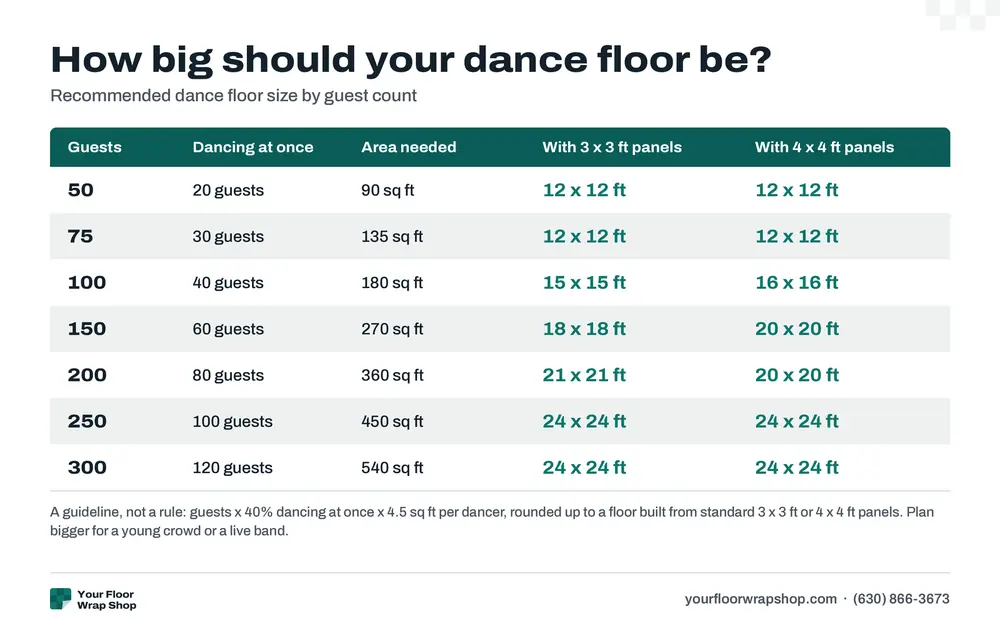
| Guests | Peak dancers | Area needed | Common floor sizes |
|---|---|---|---|
| 50 | 20 to 25 | 90 to 113 sq ft | 10 x 10 ft or 10 x 12 ft |
| 75 | 30 to 38 | 135 to 171 sq ft | 12 x 12 ft or 12 x 14 ft |
| 100 | 40 to 50 | 180 to 225 sq ft | 14 x 14 ft or 15 x 15 ft |
| 150 | 60 to 75 | 270 to 338 sq ft | 16 x 18 ft or 18 x 18 ft |
| 200 | 80 to 100 | 360 to 450 sq ft | 20 x 20 ft or 20 x 22 ft |
| 250 | 100 to 125 | 450 to 563 sq ft | 21 x 21 ft or 24 x 24 ft |
| 300 | 120 to 150 | 540 to 675 sq ft | 24 x 24 ft or 24 x 28 ft |
When to go bigger or smaller
- Go bigger if your crowd loves to dance, you have a live band, or you’re planning cultural dances where the whole room joins in, such as a hora or a large circle dance.
- Go smaller if many guests are older, the event is mostly cocktail-style, or a large share are kids who’ll be in and out.
- Don’t oversize. A floor that’s too big looks empty in photos and costs more to wrap. A slightly snug floor feels busier and more fun.
Portable dance floor panels change your size
Many venues don’t have a built-in dance floor. They lay a portable floor made of interlocking panels, often over carpet. Rental and commercial portable floors are commonly built from 3 x 3 ft or 4 x 4 ft panels, with a trim edge around the outside.
That means the floor only comes in certain sizes:
- With 3 x 3 ft panels: 12, 15, 18, 21, 24 ft and so on
- With 4 x 4 ft panels: 12, 16, 20, 24, 28 ft and so on
So if the math says 300 sq ft, the venue might set an 18 x 18 ft floor with 3 ft panels or a 16 x 20 ft floor with 4 ft panels. Ask your venue which panels they use and how many they have, then pick the closest size. That number, not the formula, is what your wrap is printed to.
How to measure your floor for a wrap
If the floor already exists, measure it in person if you can. If it’s a portable floor that isn’t set up yet, get the panel size and count from the venue.
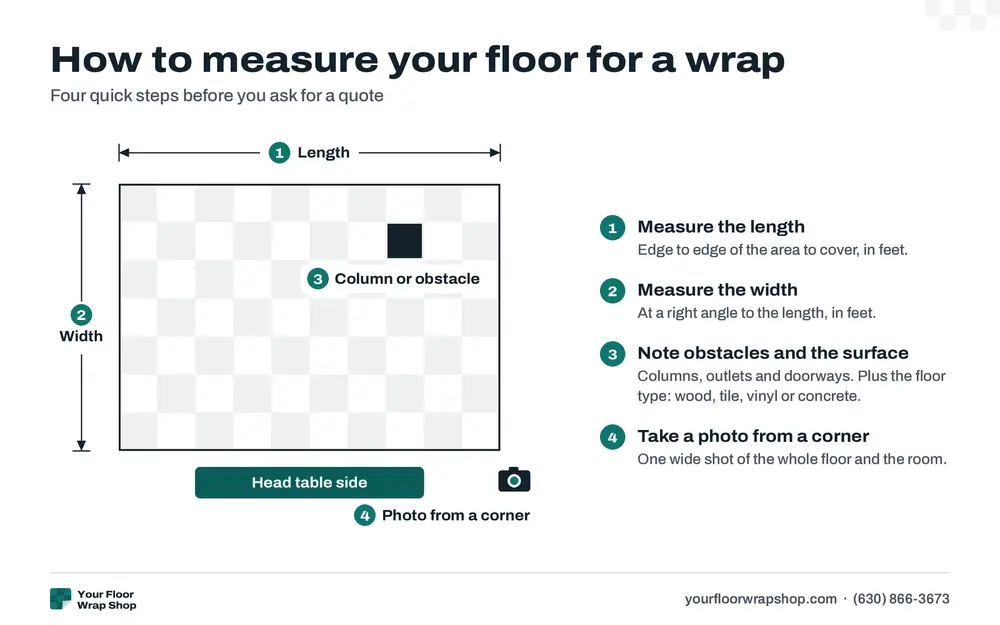
- Use a tape measure or laser measure, not a phone app. Phone measuring apps are fine for a rough idea but less reliable over a long floor.
- Measure the width wall-to-wall or edge-to-edge of the dance area at the front, middle and back. Write down all three.
- Do the same for the length on the left, center and right.
- Use the smallest numbers. Floors and rooms are rarely perfectly square, and a wrap that’s slightly smaller than the floor looks clean, while one that’s too big has to be trimmed on site.
- On a portable floor, measure the panel area inside the trim and note the trim width separately. Count the panels in each direction as a check: 6 panels of 3 ft should equal 18 ft.
- Note anything that sits on the floor: DJ booth, stage edge, columns, floor outlets, a step down or threshold.
- Mark where the head table, sweetheart table or stage sits relative to the floor. This decides which way your monogram faces.
- Write down the floor material: hardwood, tile, sealed concrete, vinyl plank, portable panels or carpet.
If the dance area is carpeted, the wrap goes on a hard subfloor laid on top, not on the carpet itself. See will a floor wrap damage the venue floor? for which surfaces work.
Photo checklist to send us
Good photos save a site visit and prevent surprises. Send these with your quote request:
- One wide photo of the whole dance area from a corner
- One straight-on photo from where the head table or stage will be
- A close-up of the floor surface, with a coin or your shoe for scale
- A close-up of any seams, panel edges or trim
- Any obstacles: columns, outlets, ramps, thresholds, built-in stages
- A photo of the venue’s floor plan or layout diagram if they have one
- Your measurements written on a sketch, even a rough one on paper
Also include the venue name and address, your event date, your setup window (when the room opens to vendors), and guest count.
From size to price
Once you have the size, pricing is simple: square feet times $8 shipped or $11 installed (with a $750 installed minimum). A 16 x 16 ft floor is 256 sq ft, so $2,048 shipped or $2,816 installed. See how much a dance floor wrap costs for a full table, or go straight to our pricing page.
Questions people ask
How many square feet per person do you need on a dance floor?
The common working number is about 4.5 sq ft per dancer, with a typical range of 4 to 5 sq ft. Multiply that by the number of people you expect dancing at once, not your full guest count.
What percentage of guests dance at a wedding?
Typically 40 to 50 percent at the busiest moment of a wedding. General parties tend to run 30 to 40 percent and corporate events lower.
What size dance floor do I need for 150 guests?
About 270 to 338 sq ft, which fits a 16 x 18 ft or 18 x 18 ft floor. Final size depends on the venue’s panels and room layout.
Can you wrap a floor that’s an odd size or shape?
Yes. The wrap is printed to your measurements, so a 14 x 19 ft floor or an unusual shape is fine. If there is a column or built-in stage, tell us and we will plan the design around it. Accurate measurements and photos matter more in those cases.
What if the venue hasn’t decided on the floor size yet?
Ask which panel size they use and how many they have. That narrows it to a few possible sizes. We can quote a likely size and confirm before printing.
Have your measurements or photos ready? Call (630) 866-3673 or request a quote, and we’ll confirm the size and send a price.