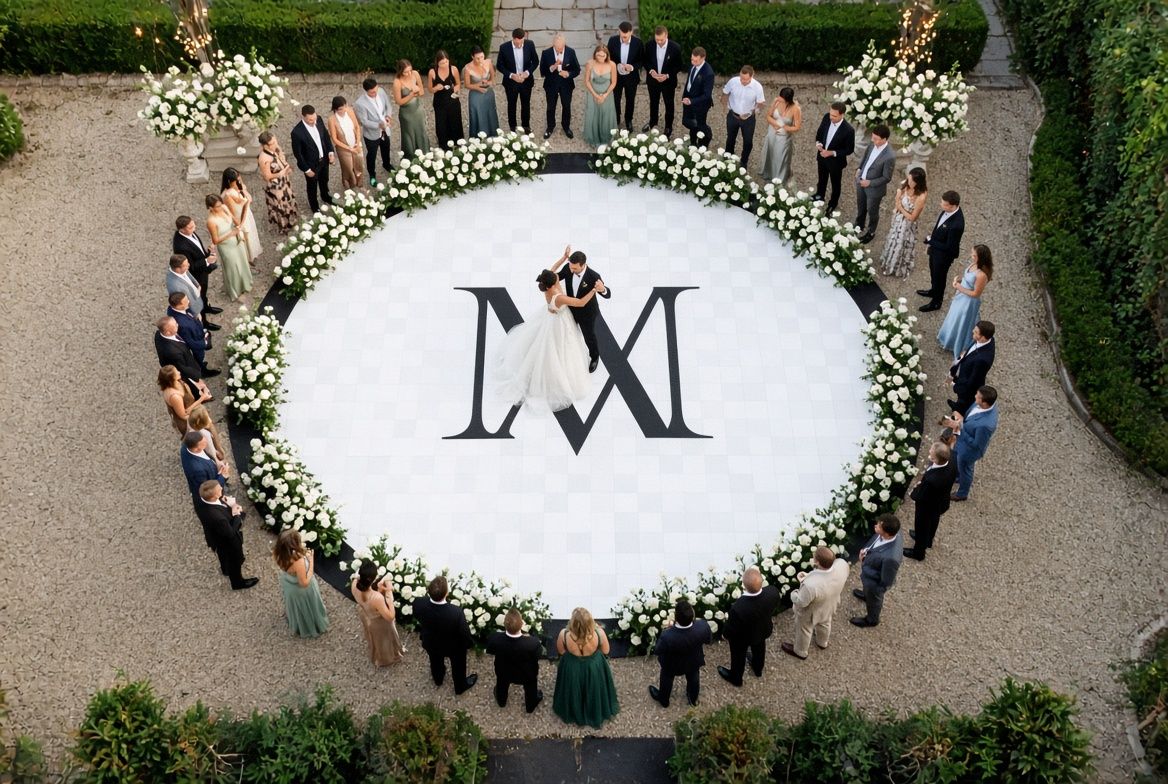
On a clean, smooth, sealed and fully cured hard floor, a floor wrap made with removable adhesive is designed to come up without damaging the surface. Problems usually come from the wrong surface (carpet, unsealed concrete, a freshly refinished floor) or the wrong adhesive, not from the wrap itself. Here’s how to tell whether your venue’s floor is a good fit, what slip resistance means, and what to ask your venue before you book.
Removable vs permanent adhesive
Floor graphics are printed on vinyl with an adhesive backing, then covered with a protective floor laminate. The adhesive is the part that touches the venue’s floor, so it matters most.
- Removable adhesive is made for temporary graphics. Material makers specify it for clean, smooth, sealed surfaces such as sealed concrete, commercial tile, vinyl, laminate, smooth ceramic tile and most cured, sealed wood floors. It’s meant to peel off cleanly.
- Permanent adhesive is meant for long-term graphics, like a logo in a store entrance or a warehouse marker. Manufacturers generally don’t promise clean removal, and some residue may stay behind.
- High-tack adhesive is a stronger type made for rough surfaces like commercial carpet, sidewalks and asphalt.
For a dance floor that comes up after one night, you want removable adhesive. If you’re comparing providers, ask which adhesive and laminate they plan to use on your venue’s floor. A good provider will answer plainly.
Which floors work and which don’t
| Surface | Good fit? | Notes |
|---|---|---|
| Sealed hardwood (fully cured) | Yes | Most common ballroom and event-hall floor. Must be clean and not freshly refinished. |
| Portable dance floor panels | Yes | Smooth, hard and sealed. One of the best surfaces for a wrap. |
| Ceramic or porcelain tile | Usually | Smooth tile works. Deep grout lines and heavily textured tile can show through. |
| Vinyl plank or commercial tile | Yes | Smooth and sealed. |
| Sealed or polished concrete | Yes | Common in lofts, breweries and industrial venues. Must be clean and dry. |
| Unsealed or dusty concrete | No | Dust and porosity keep adhesive from bonding well. |
| Freshly refinished or painted floor | Not yet | The finish needs to be fully cured first. |
| Carpet | Not directly | Needs a hard subfloor, like a portable dance floor, laid on top. |
Carpet
A dance floor wrap goes on a hard surface. If the dance area is carpeted, the usual answer is a portable dance floor laid over the carpet and wrapped. Many venues own one; party rental companies rent them. Portable floors are commonly built from 3 x 3 ft or 4 x 4 ft panels, which also makes them easy to measure. See how to measure your dance floor.
Freshly refinished wood
New floor finishes take time to cure fully, even after they’re dry to the touch. Flooring guidance typically says to wait about 7 to 14 days for water-based polyurethane and 21 to 30 days for oil-based before putting rugs or tape on the floor. If your venue recently refinished the floor, ask when, and don’t apply anything until that cure window has passed.
Waxed floors
Wax and floor polish can keep adhesive from bonding well and can lift unevenly. Material makers recommend degreasing and cleaning waxed floors before applying graphics. Ask your venue whether the floor was recently waxed or polished.
Slip resistance, explained
Plain vinyl is smooth, and smooth gets slippery, especially with spilled drinks and dress shoes. That’s why floor graphics are covered with a floor laminate: a clear protective layer with a textured surface that adds grip and protects the print from scuffs.
Our wraps are laminated with a textured slip-resistant floor laminate. Venues sometimes ask about slip resistance, and that’s a fair question.
What UL 410 is
UL 410 is a standard for slip resistance of floor surface materials. It measures the coefficient of friction of a surface, basically how much grip it has, in a lab setting using a test sample. It’s commonly referenced for floor graphic laminates, anti-slip films, floor coatings and finishes. Some laminate makers list UL 410 results on their spec sheets. Other slip-resistance measurements exist too, such as dynamic coefficient of friction testing under ANSI A326.3, which is commonly cited with a minimum value of 0.42 for interior floors.
We don’t advertise a UL 410 rating or any other formal test result for our wraps. If your venue requires a specific rating, tell us up front so we can talk through options before anything is printed.
Practical safety
- Keep edges flat and fully pressed down. Lifted edges are the real trip hazard, not the graphic itself.
- Wipe spills quickly, as you would on any dance floor.
- Avoid wrapping right up to steps or ramps where people change level.
Questions to ask your venue
- Do you allow floor wraps or decals? Do you have rules on adhesive type?
- What is the floor made of, and when was it last refinished, sealed or waxed?
- Do you use a portable dance floor? What panel size, and how many panels?
- Who is allowed to install and remove floor graphics? Does it need to be the installer?
- When can vendors start setup, and when does the floor need to be clear?
- Do you need a certificate of insurance or a material spec sheet from the vendor?
What happens on removal day
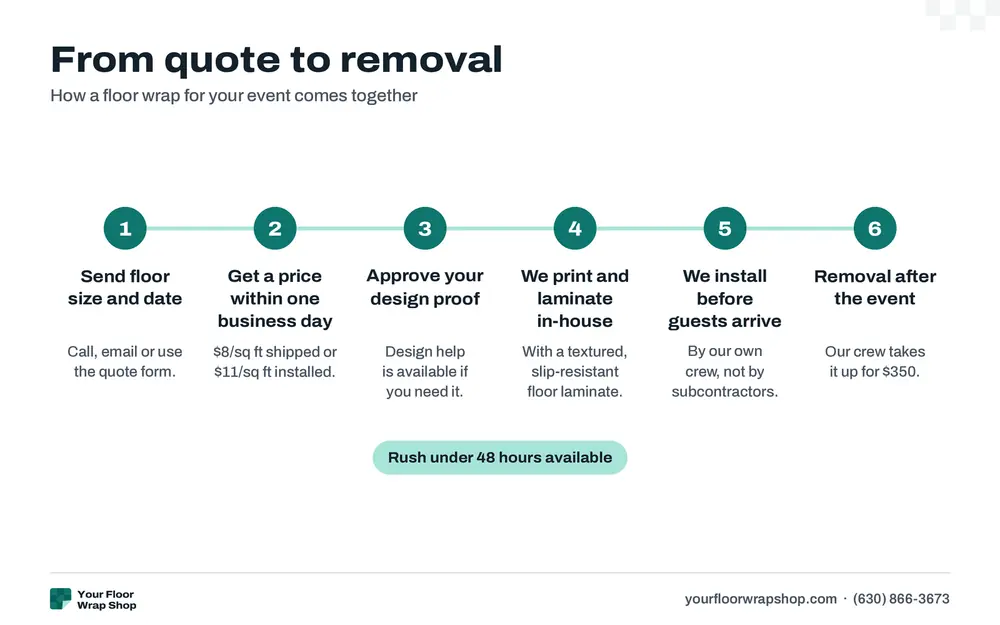
If you add removal, it’s $350 flat. We schedule it with you around your venue’s rules, so ask your venue when the floor needs to be clear. The wrap is lifted from the floor, rolled up and taken away. If your venue doesn’t require the installer to do it, your planner or venue staff can remove it instead. See our pricing page for the full list of prices.
Email template for your venue coordinator
Copy, paste and fill in the brackets:
Subject: Floor wrap for our [date] event
Hi [coordinator name], we’re planning a custom printed floor wrap for the dance floor at our [date] event. It’s a printed vinyl graphic with a textured slip-resistant laminate, applied to the dance floor and removed after the event. Could you tell us: (1) whether floor wraps are allowed, (2) what the dance floor surface is and whether it has been refinished or waxed recently, (3) whether you use a portable floor, and if so the panel size and how many panels, (4) who may install and remove it, and the setup and teardown times, and (5) whether you need insurance or spec sheets from the vendor. Our installer is Your Floor Wrap Shop, (630) 866-3673. Thank you, [your names]
Questions people ask
Will a floor wrap leave residue on a hardwood floor?
On clean, sealed, fully cured hardwood, removable adhesive is designed to come off cleanly. Residue is more likely with permanent adhesive, a fresh finish, a waxed surface or a wrap left down far longer than planned.
Can you put a floor wrap on carpet?
Not directly. Carpet needs a hard subfloor, usually a portable dance floor, and the wrap goes on that.
Are floor wraps slippery?
Plain vinyl can be. That’s why floor wraps are covered with a textured floor laminate that adds grip. Our wraps use a textured slip-resistant floor laminate.
Is your wrap UL 410 rated?
We don’t advertise a UL 410 rating or other formal slip-resistance test result. If your venue needs one, tell us before ordering so we can discuss options.
How much does removal cost?
$350 flat, for installed wraps in our service area. If your venue allows it, your own team can remove it instead.
Questions about your venue’s floor? Call (630) 866-3673 or request a quote with photos of the floor, and we’ll tell you whether it’s a good fit. More answers on our FAQ page.