Use tape or paint for long continuous lines like aisles and lane edges, and use printed floor decals for everything that carries information: signs, arrows, footprints, location numbers, PPE stops and logos. Paint is cheapest per foot but needs downtime to cure, tape goes down fast and can be moved, and decals do what neither can: print any shape, color or message. Here’s how they compare, and which colors to use for what.
Paint vs tape vs decals at a glance
| Factor | Floor paint | Floor marking tape | Printed floor decals |
|---|---|---|---|
| Best for | Long permanent lines | Lines and boxes that may change | Signs, symbols, arrows, numbers, logos |
| Material cost | Lowest per foot of line | Moderate per foot | Highest per square foot, lowest per message |
| Downtime | Typically 24 hours for light traffic, up to about a week for vehicles | Usable right away; heavy traffic often after 24 hours | No cure time; area is usable once installed |
| Forklift traffic | Good once cured; wears and stains in turning zones | Heavy-duty tapes made for it; edges can lift where tires turn | Fine for foot traffic; turning zones are hard on any applied graphic |
| Changes later | Hard to remove; old lines can show for years | Peels up, easy to move | Peels up and replace |
| Detail and color | Stencils only, limited colors | Solid colors and stripes | Any design, text or symbol, full color |
The right answer is usually a mix. A typical layout uses tape or paint for the aisle lines and decals for the information the lines can’t carry.
Floor paint
Paint is the traditional option and still the lowest material cost for long runs. A striping crew can lay hundreds of feet of aisle line quickly.
The tradeoff is downtime. Paint manufacturers typically call for about 24 hours before light foot traffic, around 72 hours before heavy foot traffic, and up to a week before vehicles with tires. In a running warehouse, that means closing aisles or working nights and weekends. Paint can also fade and stain under dragged pallets, and removing it later can mean grinding or chemical strippers. Old paint lines often stay faintly visible after removal.
Paint makes sense for permanent long lines in areas where layout won’t change, and when you can afford the cure time.
Floor marking tape
Industrial floor tape goes down without a cure time, and heavy-duty versions are made for forklift traffic and pallet drags. When the layout changes, it peels up. That flexibility is why tape is popular in lean and 5S programs, where cells and staging areas get rearranged.
Watch for edge lifting where tires turn and on dirty or unsealed concrete. Surface prep matters as much as the tape. Tape is best for aisle lines, cell outlines, staging boxes and anything you expect to move.
Printed floor decals
Floor decals are printed graphics, laminated with a textured protective layer and applied to the floor. They aren’t the cheapest way to make a long line. Where they win is anything that needs to say something.
Where decals are the right tool
- Directional arrows and one-way traffic signs at intersections
- Stop signs and “look both ways” marks where pedestrian walkways cross forklift lanes
- PPE stops: “safety glasses required beyond this point,” hearing or hard hat zones
- Footprints and standing positions at stations, scanners or shipping counters
- Location numbers for racking bays, dock doors and staging lanes
- Keep-clear marks in front of electrical panels, fire extinguishers and eyewash stations
- Corner marks and L-shapes for pallet positions
- Company logos and branded wayfinding in visitor areas
A decal can combine a symbol, a word and a color in one piece, which is much faster to read than a painted stencil. It’s also easy to update when a procedure changes.
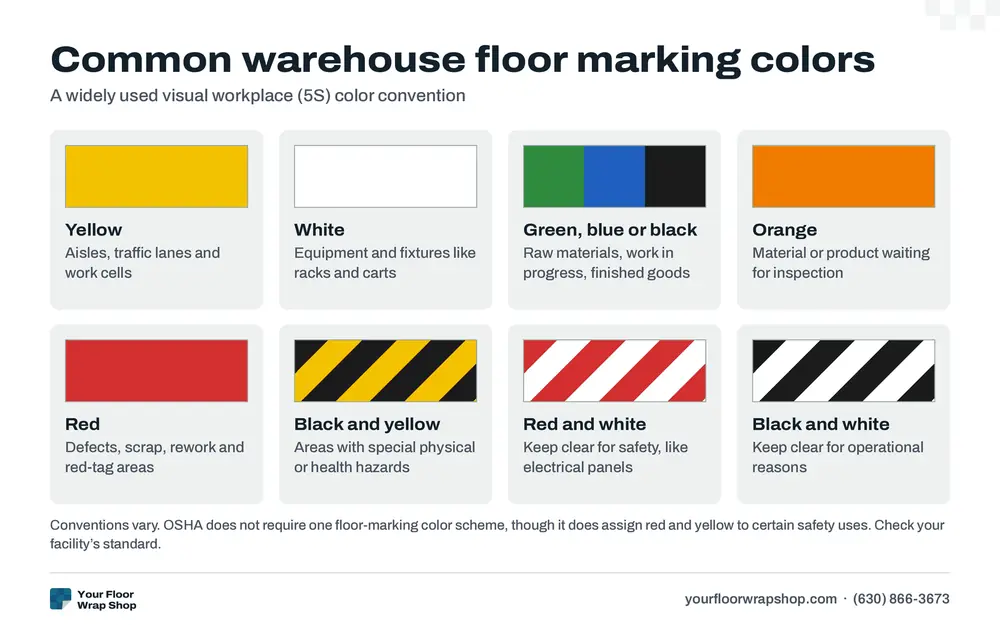
The common floor marking color convention
There’s no single government-mandated color scheme for floor marking. In practice, many facilities follow a widely used visual-workplace convention, often associated with 5S programs:
| Color | Commonly used for |
|---|---|
| Yellow | Aisles, traffic lanes and work cells |
| White | Equipment and fixtures like workstations, carts and racks |
| Blue, green or black | Raw materials, work in progress and finished goods |
| Orange | Material or product waiting for inspection |
| Red | Defects, scrap, rework and red-tag areas |
| Red and white stripes | Keep clear for safety or compliance, such as in front of electrical panels and fire equipment |
| Black and white stripes | Keep clear for operational reasons |
| Yellow and black stripes | Areas with physical or health hazards |
The point is consistency. Pick a scheme, write it down, post it, and use it the same way across the whole building.
What OSHA actually says
OSHA’s materials handling rule, 29 CFR 1910.176(a), says that “permanent aisles and passageways shall be appropriately marked.” It doesn’t say what color or what method. OSHA interpretations have said aisle lines can be any color, as long as they clearly mark the aisle and are used consistently. Width guidance commonly cited from OSHA interpretations is lines at least 2 inches wide.
Color does come into play for hazards. OSHA’s safety color code, 29 CFR 1910.144, makes red the basic color for danger and fire protection equipment, and yellow the basic color for caution and marking physical hazards such as tripping, falling and striking against objects.
You’ll sometimes see ANSI Z535 mentioned as a floor marking standard. Its focus is safety signs and colors, and floor marking guidance built on older editions is no longer considered current. For your own facility, check with your safety lead or consultant on what applies to you.
We don’t make compliance claims for the decals we install. We make the graphics you specify, in the colors your safety plan calls for.
Where we fit, honestly
We measure, print and install floor decals for warehouses, plants and distribution centers across Chicagoland, southeast Wisconsin and northwest Indiana. That includes arrows, stop marks, PPE stops, footprints, location numbers, keep-clear zones and custom safety graphics. Our material supplier is a few minutes away, so local jobs can often be scheduled the same week. Commercial work is quoted per project. See commercial floor graphics for more.
If your job is mostly long aisle lines across a large building, a striping contractor with paint or tape equipment is usually the better and cheaper choice for the lines. We’re a good fit for the decals that go with them.
Questions people ask
Are floor decals durable enough for a warehouse?
Laminated floor decals hold up well to foot traffic and are commonly used in warehouses. Spots where forklifts turn sharply or pallets are dragged are hard on any applied graphic, so place decals just outside turning zones where you can.
Does OSHA require yellow aisle lines?
No. OSHA requires permanent aisles and passageways to be appropriately marked but doesn’t set an aisle color. Yellow is a common choice by convention. Red and yellow have defined meanings for danger and caution under OSHA’s safety color code.
How long until we can drive on new floor markings?
Paint typically needs anywhere from 24 hours to about a week depending on traffic type. Tape and decals don’t need cure time like paint does.
Can decals go on unsealed concrete?
Clean, smooth, sealed concrete gives the best bond. Dusty or unsealed concrete makes it harder for any adhesive to hold. Send photos of the floor and we’ll tell you what to expect.
Can you print our own safety signs and logo?
Yes. We print custom decals from your artwork or build the design for you.
Planning floor markings for your facility? Call (630) 866-3673 or request a quote with your floor plan and a list of what needs marking.